

This past weekend, the kicking industry was buzzing after Jacksonville Jaguars rookie Cam Little reportedly drilled a 70-yard field goal in practice. A kick from that distance is a rare feat of strength, technique, and ideal conditions coming together in a perfect storm.
But was it just raw talent, or did other factors play a role? As specialists, it’s our job to look beyond the highlight and analyze the mechanics and conditions that make such a kick possible. Let’s break down the key elements, from a crucial new NFL rule to the technical details of Little’s form.
The “K Ball” Rule Change: A Kicker’s Secret Weapon?
For years, NFL kickers have had to deal with kicking brand-new, out-of-the-box footballs (known as “K balls”) that were often slick, hard, and unforgiving. However, a significant rule change for the 2025 season now allows teams to “prepare” their kicking balls before games, similar to how quarterbacks break in their own game balls.
Here are a list of rules changes for 2025 from FOX sports: https://www.foxsports.com/stories/nfl/2025-nfl-rule-changes-tweaks-made-regular-season-ot-kickoffs-replay-assist
This means kickers can now work with balls that have been softened, scuffed, and conditioned to their exact preference. A properly prepared ball offers a better grip for the holder and a more forgiving surface for the kicker’s foot to connect with. This improved texture and pliability can lead to better compression on impact, which translates directly to more energy transfer and, ultimately, more distance.
Could this new rule have played a role in Little’s 70-yard bomb? Absolutely. While we don’t know the exact condition of the ball he used, having the ability to kick a ball that’s properly broken in—rather than a rock-hard one straight from the factory—can provide a significant physical and psychological advantage when attempting a kick from extreme distance.
A Technical Deep Dive into the Kick
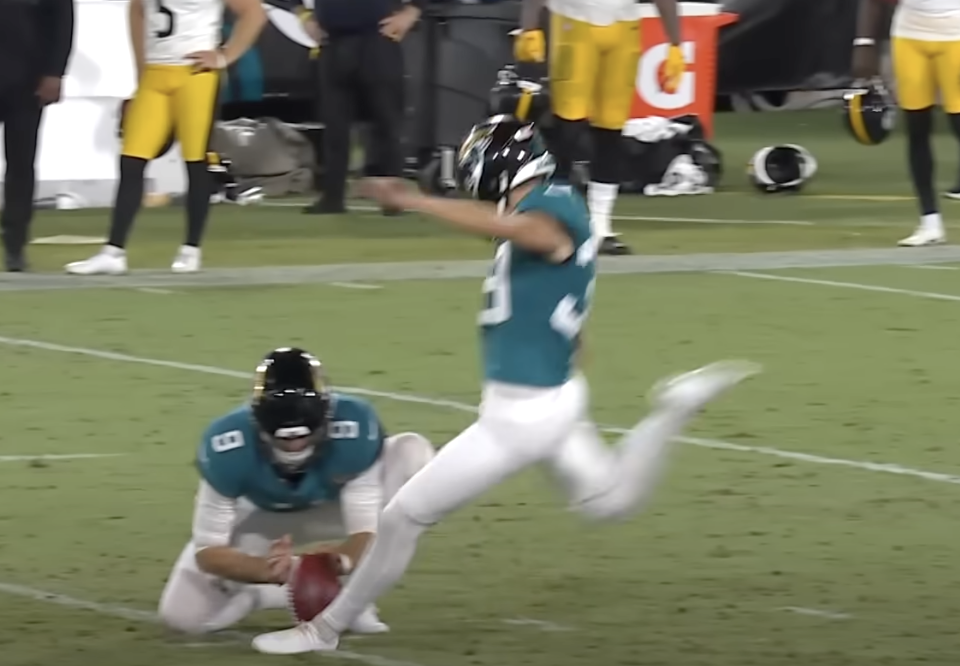
When attempting a max-distance field goal, many kickers alter their form, adding extra steps or over-swinging in a desperate search for more power. What made Little’s kick so impressive was his commitment to his core technique, with a few key adjustments for maximum distance.
- He Didn’t Change His Approach: The first thing to notice is that Little maintained his standard, rhythmic approach. There was no extra-long run-up or stutter step. This is crucial because it ensures that his timing, tempo, and plant foot placement remain consistent, allowing him to trust his mechanics without introducing new, uncontrolled variables.
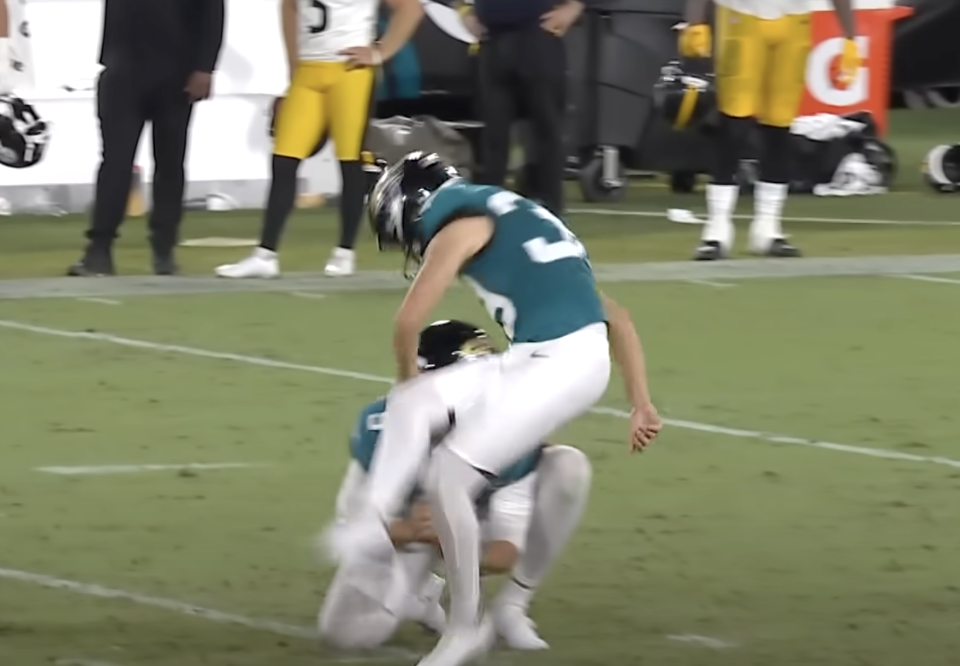
- The “Kickoff Crunch”: The most visible adjustment was how much he “crunched down” at the point of contact. You can see his shoulders drop significantly as his body compresses over the ball. This is a technique often seen in kickoffs, where the goal is maximum power. By lowering his center of gravity and aggressively crunching his core, he generated incredible leverage and rotational force, transferring that energy directly into the ball (see image below).
- Playing the Hash Marks: Little kicked from the right hash mark. For a right-footed kicker who naturally plays a draw (a right-to-left ball flight), this is a strategic advantage. It allows him to aim at the right upright and trust his natural ball flight to bring the kick back toward the center. This approach lets him swing freely and powerfully without having to worry about over-correcting or “guiding” the ball.
- Imperfect Technique, Perfect Contact: From a purely technical standpoint, his form wasn’t flawless—there’s always room for refinement. However, the most important factor in any kick is finding the “sweet spot” on the ball. Little’s ability to make clean, solid contact on the perfect panel of the football overrode any minor technical imperfections. This is a testament to his consistency and body awareness.
The X-Factors: Temperature and Wind
While we can analyze technique all day, we can’t ignore the environmental conditions. For a complete picture, we would need to know two things:
- Temperature: A warmer, more humid day makes the air less dense, allowing the ball to travel farther. A warmer ball is also more pliable and has a higher coefficient of restitution (it “bounces” off the foot better).
- Wind: Was there any wind, and if so, was it at his back? Even a slight tailwind of 3-5 mph can be the difference between a kick that hits the crossbar and one that sails over it.
We are still working to confirm the exact weather conditions at the time of the kick, including the temperature and the potential impact of wind. We will provide an update as soon as that information is available. (Roughly 58,300 fans)
A Sign of Things to Come? Get Ready for More Long Bombs
Don’t be surprised if Cam Little’s 70-yarder isn’t the longest field goal we hear about this season. This kick, combined with the new rules, is likely to usher in a new era of long-range attempts across the league.
For years, the 63-64 yard mark has felt like a hard ceiling in the NFL. But with the “K ball” rule giving kickers better equipment to work with, that ceiling is poised to be shattered. The psychological barrier is just as important; when one kicker proves something is possible, the belief spreads. Coaches and kickers will see this and start pushing the boundaries in practice and, eventually, in games. Expect to see more teams attempting 60+ yard field goals at the end of a half. What was once a desperation heave is now becoming a calculated risk, thanks to better technique, stronger athletes, and now, better footballs.
After the game video interview breakdown:
In this post-game interview, Jacksonville Jaguars rookie kicker Cam Little discusses his remarkable, 70-yard field goal made during a preseason game. He appears humble, articulate, and thoughtful, balancing the excitement of the moment with a mature perspective on his profession. Little talks through the kick itself, admitting some initial doubt but also his eagerness to attempt it based on his training. He expresses gratitude for the coach’s confidence and describes the electric atmosphere in the stadium. Throughout the interview, he touches on the rising expectations for NFL kickers, his personal background (former soccer player), and the mental framework, rooted in his faith, that allows him to handle high-pressure situations.
The Takeaway
Cam Little’s 70-yard field goal was more than just a big leg. It was a combination of trusting his foundational technique, making smart adjustments for power, and likely benefiting from the new “K ball” rule. It serves as a powerful reminder for all our athletes at The Kicking System: consistency in your approach, combined with an understanding of how to generate leverage, is the key to unlocking your true distance potential.

 Kicking System
Leave a comment